
2Department of Nutrition and Dietetics, Osmaniye Korkut Ata University, Faculty of Health Sciences, Osmaniye, Türkiye
3Department of Physiology, Tokat Gaziosmapaşa University, Faculty of Medicine, Tokat, Türkiye
Abstract
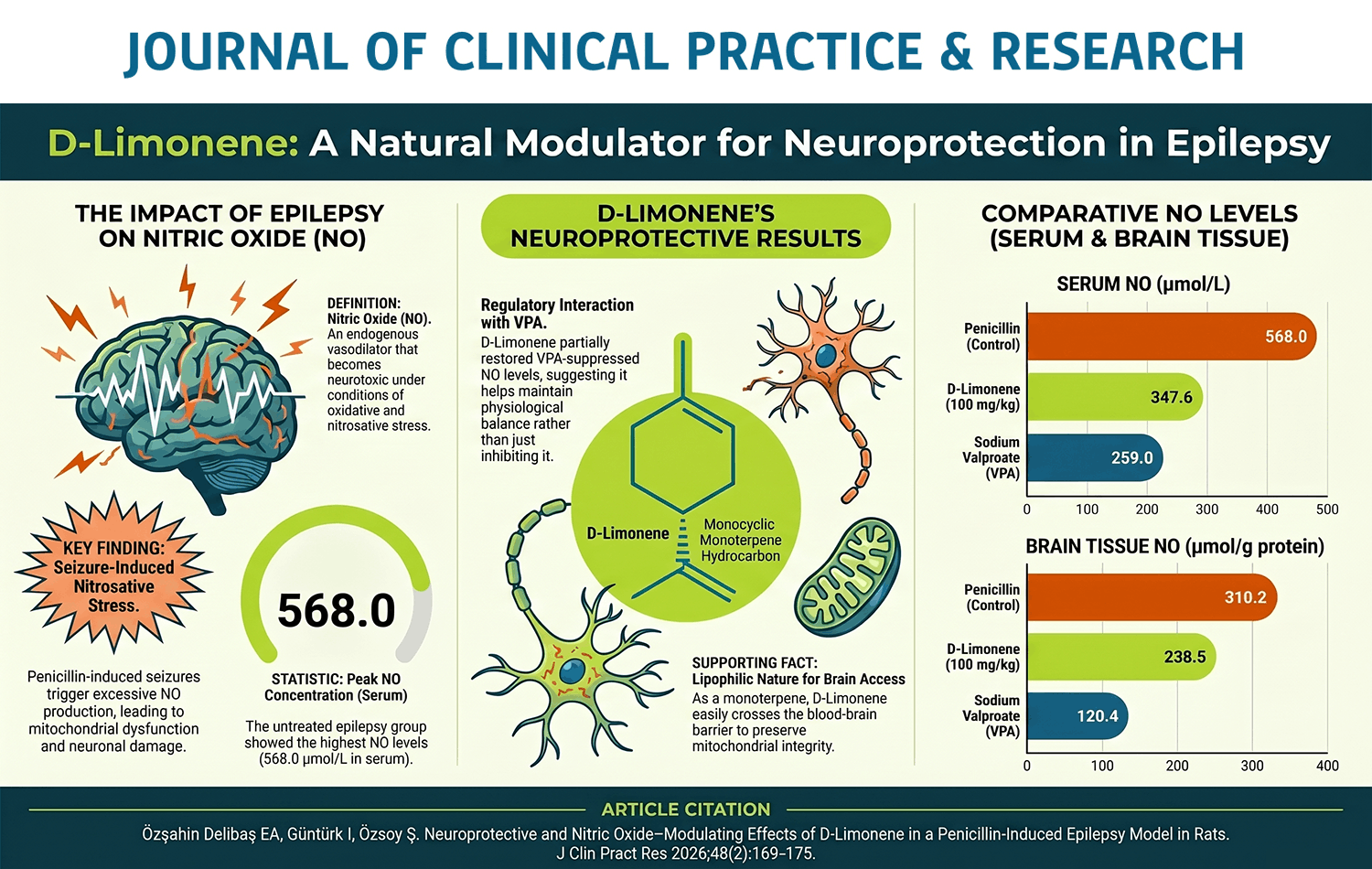
Objective: Epilepsy involves dysregulated inflammatory pathways and oxidative stress (OS). Nitric oxide (NO), an endogenous vasodilator, may exert neurotoxic effects under OS. D-limonene, a monoterpene with antioxidant and anti-inflammatory properties, can modulate these processes. This study addressed the neuroprotective effects of D-limonene by assessing its influence on NO levels in serum and brain tissue and its interaction with sodium valproate (VPA) in a penicillin-induced epilepsy model in rats.
Materials and Methods: Thirty-five male Wistar albino rats (12–16 weeks, 200±50 g) were clustered into 5 groups (n=7): control (penicillin 500 IU, 2.5 µL, i.c.); D-limonene 50 mg/kg + penicillin 500 IU; D-limonene 100 mg/kg + penicillin 500 IU; VPA 300 mg/kg + penicillin 500 IU; and combination (D-limonene 100 mg/kg + VPA 300 mg/kg + penicillin 500 IU). Treatments were administered intraperitoneally. NO levels were determined using a commercial colorimetric assay kit. Data were analyzed using one-way ANOVA followed by Sidak’s multiple comparisons test and are presented as mean±SD, with statistical significance set at p<0.05.
Results: Serum NO peaked in the penicillin group (568.0±84.95 µmol/L) and decreased dose-dependently with D-limonene (490.5±86.12; 347.6±25.39 µmol/L). VPA further reduced NO (259.0±20.04 µmol/L), whereas the combination modestly increased it (390.6±74.95 µmol/L). Tissue NO showed a similar trend, with the lowest level observed with VPA (120.4±12.60 µmol/L) and partially restored by combination treatment (168.8±20.85 µmol/L).
Conclusion: D-limonene reduced NO levels dose-dependently. VPA had a stronger inhibitory effect, whereas their combination attenuated this inhibition, suggesting that D-limonene may modulate NO metabolism and confer neuroprotection in experimental epilepsy.
Graphical Abstract