
2Department of Histology and Embryology, Faculty of Medicine, Van Yüzüncü Yıl University, Van, Türkiye
Abstract
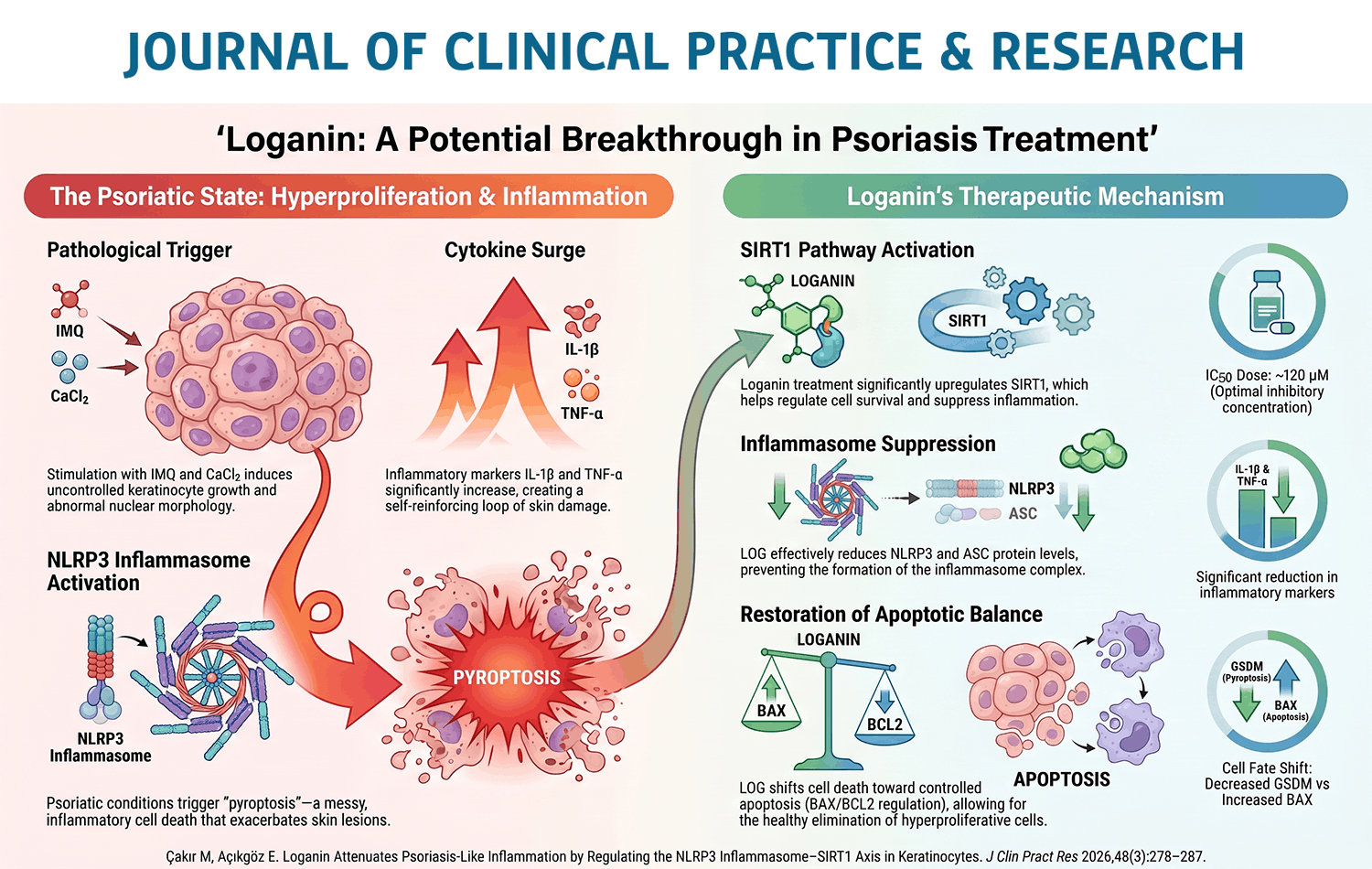
Objective: The development of psoriasis involves disrupted signaling interactions between immune components and keratinocytes, leading to a chronic autoimmune state characterized by sustained inflammatory responses and epidermal hyperplasia. This study aimed to elucidate the anti-inflammatory potential of loganin (LOG) against the inflammasome–SIRT1 signaling pathway in a CaCl₂- and imiquimod (IMQ)-induced cellular model.
Materials and Methods: HaCaT cells were differentiated using CaCl₂ and IMQ to establish a psoriasis-like inflammatory model. Cell viability and the IC50 dose of LOG were determined using the MTT assay. Morphological alterations were assessed by hematoxylin and eosin (H&E) staining. Protein expression levels of NLRP3, ASC, and SIRT1 were analyzed using immunofluorescence staining. In addition, IL-1β and TNF-α levels were quantified by enzyme-linked immunosorbent assay (ELISA), while the expression of genes related to the inflammasome, pyroptosis, and apoptosis was measured using qPCR.
Results: Differentiation of HaCaT cells was induced by CaCl₂ and IMQ to establish an in vitro model of psoriatic inflammation. Following treatment, the MTT assay was used to determine the LOG IC50 dose and overall cell viability. Structural changes were documented using hematoxylin and eosin (H&E) staining. The protein expression status of NLRP3, ASC, and SIRT1 was characterized using immunofluorescence staining. In addition, enzyme-linked immunosorbent assay (ELISA) was used to quantify IL-1β and TNF-α levels, whereas the expression profiles of genes associated with apoptotic and pyroptotic signaling were analyzed by qPCR.
Conclusion: LOG exerts potent anti-psoriatic effects by suppressing NLRP3 inflammasome-mediated pyroptosis and restoring apoptotic competence in hyperproliferative keratinocytes through SIRT1 activation. These findings highlight LOG as a promising translational candidate for targeting keratinocyte-driven inflammation in psoriasis and warrant further preclinical and clinical investigation.
Graphical Abstract