
2Department of Biomedical Engineering, Erciyes University, Kayseri, Türkiye; NanoThera Lab, ERFARMA-Drug Application and Research Center, Erciyes University, Kayseri, Türkiye; ERNAM-Nanotechnology Research and Application Center, Erciyes University, Kayseri, Türkiye; ERKAM-Clinical-Engineering Research and Implementation Center, Erciyes University, Kayseri, Türkiye; GENKOK-Betül-Ziya Eren Genome and Stem Cell Center, Erciyes University, Kayseri, Türkiye
Abstract
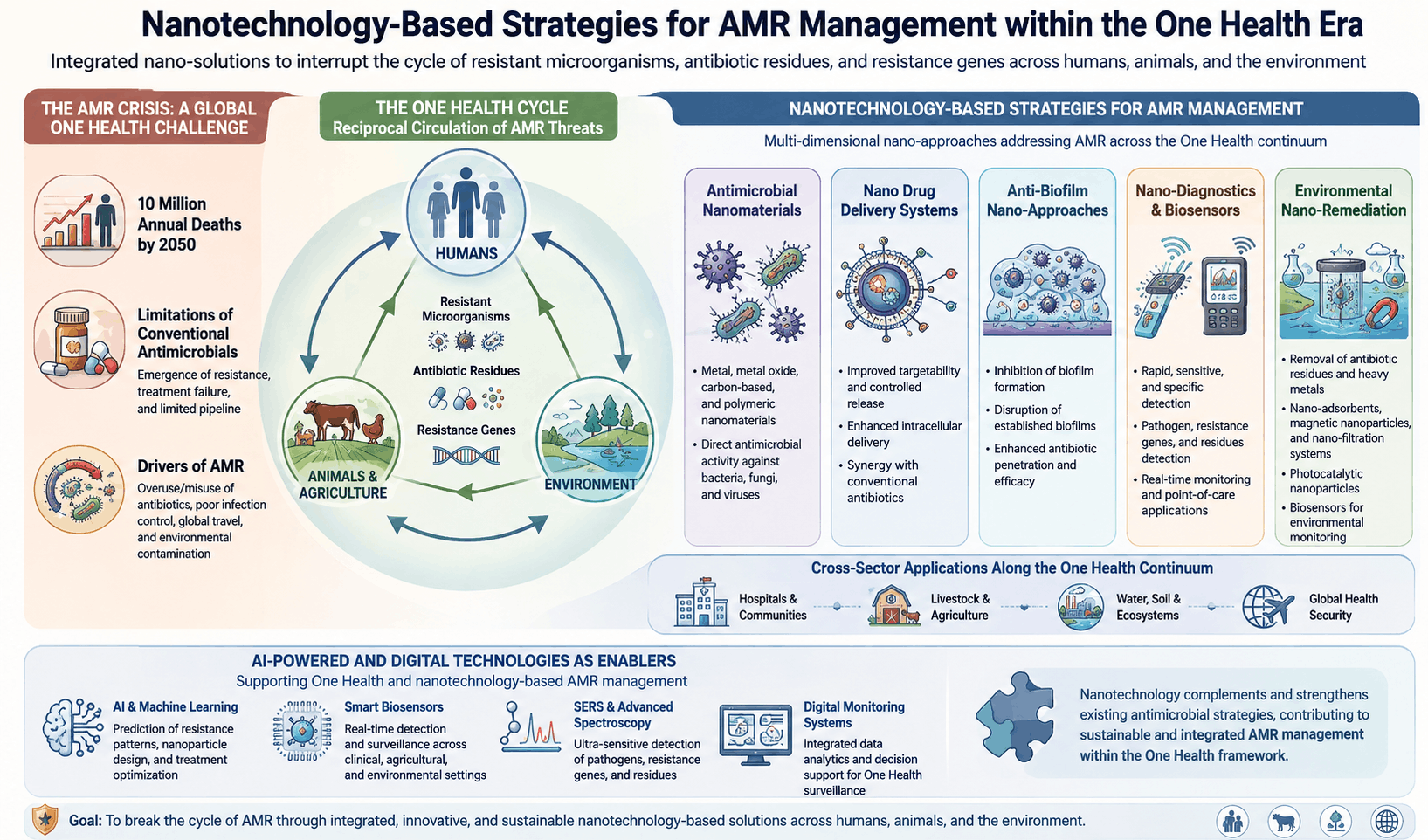
Antimicrobial resistance (AMR) has emerged as one of the greatest global public health threats, compromising the effectiveness of antibiotics and jeopardizing advances in modern medicine. The extensive use and misuse of antimicrobial agents in human medicine, veterinary practice, agriculture, and aquaculture have accelerated the emergence and spread of multidrug-resistant microorganisms. Because resistant pathogens, antibiotic residues, and resistance genes continuously circulate among humans, animals, and the environment, AMR is now recognized as a complex One Health challenge requiring coordinated, multidisciplinary solutions. However, conventional strategies, including the development of new antibiotics and antimicrobial stewardship programs, are increasingly constrained by rapid microbial adaptation, biofilm formation, delayed diagnosis, and the declining antibiotic discovery pipeline. Nanotechnology has emerged as a promising interdisciplinary platform capable of addressing several limitations of conventional antimicrobial approaches. Nanomaterials possess intrinsic broad-spectrum antimicrobial activity, enhance targeted drug delivery, improve biofilm eradication, and enable rapid pathogen detection through advanced nanodiagnostic systems. Furthermore, integrating nanotechnology with artificial intelligence, machine learning, and smart biosensing technologies is accelerating the development of precision antimicrobial therapies and real-time AMR surveillance systems. This review discusses the AMR crisis from a One Health perspective and summarizes recent advances in antimicrobial nanomaterials, nanodrug delivery systems, antibiofilm strategies, and nanodiagnostics. Current translational challenges and future perspectives are also highlighted, emphasizing the potential of nanotechnology to support sustainable AMR management across interconnected human, animal, and environmental sectors.
Graphical Abstract